Strength, Agility, Stamina: the other three stats each have their own guide on this blog. Speed didn't, and that is no accident. It is the most misunderstood stat in the game, the one that produces the best-looking brutes on paper and the most disappointing ones in the arena. Here is exactly what it does, with the engine's numbers to back it up.
Speed does only one thing
There are no turns in the classic sense in My Brute Legacy. The engine runs a loop, and on each pass both fighters fill an action gauge. When a gauge reaches 100%, its owner strikes, then spends the equivalent of a full gauge. That's it.
What speed governs is how fast the gauge fills, and it does so through a square root:
fill per pass = square root of your SPD × 7
In practice:
- SPD 10: 22.1 per pass, one hit every 4.5 loops.
- SPD 20: 31.3 per pass, one hit every 3.2 loops.
- SPD 40: 44.3 per pass, one hit every 2.3 loops.
- SPD 80: 62.6 per pass, one hit every 1.6 loops.
- SPD 160: 88.5 per pass, one hit every 1.1 loops.
Look closely at the progression. Going from 20 to 40 means doubling the stat to gain 41% more attacks. Going from 20 to 80 means quadrupling it to double their number. You need four times the speed to strike twice as often. Every point invested is worth less than the one before, and it is the only stat in the game built that way.
And it does nothing else
This is where speed builds die. The damage formula is this:
base damage = 8 × (100 + your STR × 7) / 100, plus your weapon's damage bonus
Speed isn't in it. Neither is agility: its damage coefficient is zero in the current configuration. Dodge depends on the ratio between the target's agility and the attacker's, and critical chance is 5% plus 0.6% per agility point, capped at 50%.
In other words: speed gives you no damage, no dodge and no crits. It multiplies how often you apply the damage you have from elsewhere. It is a multiplier, not a source.
The all-in speed trap, in numbers
Let's take two level 50 brutes with the same Phoenix Staff (average bonuses: +6 damage, +4 SPD), the same Staff Master skill, and compare what they deal per loop pass.
Brute A, all in on speed: SPD 60, STR 5. With the weapon's bonus and affinity, it reaches 73 effective speed, so one hit every 1.67 loops. Each hit deals 19 damage. Output: 11.4 damage per loop.
Brute B, speed and strength: SPD 40, STR 35. It reaches 50 effective speed, so one hit every 2.02 loops. Each hit deals 38 damage. Output: 18.9 damage per loop.
Brute B strikes 20% less often and deals 65% more damage. That is the mechanical result of the square root: past a certain point, an extra speed point brings so little that it is always better placed in strength.
The practical conclusion fits in one sentence: speed is never an end in itself, it is an accelerator you plug into existing damage.
Speed affinity weapons are all staffs

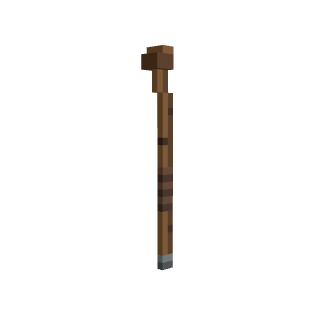


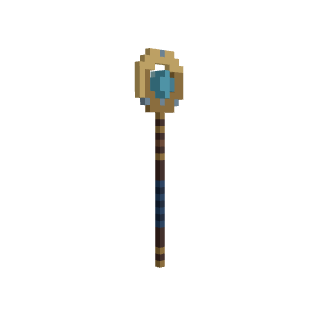
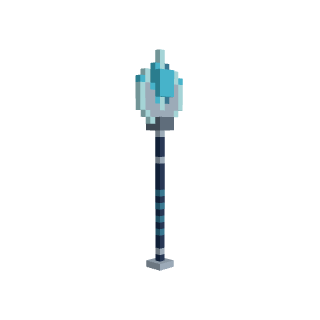

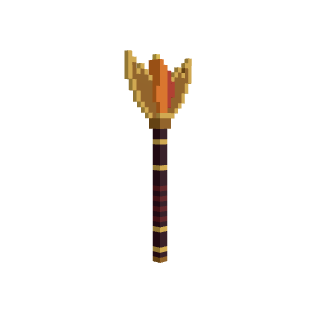
Across all the weapons in the game, the ones with speed affinity all belong to the staff category, without exception. There is no alternative: playing speed means playing a staff. Here they are in the order they unlock, bearing in mind that the required level is specific to each weapon and can't be inferred from its rarity.
- Wand (common, level 0): +0 to 2 SPD, +1 to 2 damage. A possible starting weapon.
- Wayfarer's Staff (common, level 1): +0 to 2 SPD, +1 to 2 damage, +0 to 2 AGI. The same ranges as the Wand, only longer.
- Ember Torch (uncommon, level 5): +1 to 2 SPD, +2 to 3 damage.
- Amethyst Wand (rare, level 12): +2 to 4 SPD, +3 to 5 damage, and zero strength. The best value in the mid-game.
- Tide Staff (rare, level 14): +2 to 4 SPD, +3 to 5 damage, +1 to 3 AGI. The Amethyst Wand's equivalent, in a different shape.
- Crystal Scepter (epic, level 21): +1 to 3 SPD, +3 to 5 damage, plus 2 to 4 agility.
- Frost Scepter (epic, level 25): +2 to 4 SPD, +4 to 6 damage, +1 to 3 AGI. The best speed short of a legendary.
- Phoenix Staff (legendary, level 35): +3 to 5 SPD, +5 to 8 damage, +2 to 4 AGI. The culmination.
- Phoenix Scepter (legendary, level 38): +3 to 5 SPD, +5 to 8 damage, +2 to 4 AGI, and up to 1 strength. The Staff's twin, same ranges, same peak.
Affinity adds 15% of your effective stat as a bonus to that same stat. On a staff, it therefore converts speed into speed: at 44 SPD weapon included, you get 6 more points. With Weapon Harmony (rare, level 10), the ratio goes to 30% and those 6 points become 13. It is the only skill in the game that, on this build, pays for itself twice.
A detail worth knowing: the staff is the only ranged weapon in the game. It doesn't strike: it casts a spell and then fires a projectile, so the impact lands later in the animation than a dagger hit. In a race to the death where both brutes are down to a few hit points, that delay matters.
The skills that actually change something
In order of real priority for this build:
1. Staff Master (common): +12% damage with a staff. Since you will be playing a staff anyway, it is the best common card you can draw. 2. Weapon Harmony (rare, level 10): affinity at 30% instead of 15%. See above. 3. Weapon Mastery (common): +20% to your weapon's stat bonuses. On a Phoenix Staff at +5 SPD, that makes one more point, which then feeds back into the affinity. 4. ADRENALINE (ultimate, level 20): a bonus attack every 5 turns. A free attack that costs no gauge, on a build whose whole point is the number of attacks. 5. Double Strike (rare, level 10): a 12% chance to deliver an immediate attack after a hit. The more often you strike, the more often that die gets rolled. 6. Initiative (common): your gauge starts at 25% instead of 0%. 7. Charge (common): fills 30% of a full gauge at the start of the fight. Combined with Initiative, you start the fight at 55%. At SPD 40, that means striking on the second pass instead of the third. 8. Rush (common): +20% damage on your first attack, which will come before your opponent's. 9. Combat Study (common): +1% crit per elapsed turn, up to +8%. A fast build sees a lot of turns go by.
What you should turn down without hesitation: anything purely defensive. Leather Armor, Shell, High Guard. A speed build that also tries to soak damage ends up doing neither.
You don't spread your points, you make trade-offs
One thing build guides often forget to mention: you don't freely choose your stats after creation. At creation, you have 12 points with a minimum of 2 per stat. After that, each level-up offers you two cards, and you take one.
The first card is always a stat, +5 to a randomly drawn stat. The second is a skill half the time, and otherwise another stat. The draw is deterministic for a given level: rerolling won't change anything.
So the practical rule for a speed build is:
- An SPD card on offer gets taken, always, as long as you are below 50.
- Above 50 speed, a STR card is worth more than an SPD card. Reread the comparison of the two brutes above.
- A skill from the list above comes before any stat card.
- An HP card isn't junk. A speed build strikes often but takes hits poorly, and dying on turn 6 cancels the whole frequency advantage.
A typical fight
You open at 55% gauge thanks to Initiative and Charge. Your first hit lands before your opponent's and benefits from Rush. From there, you deliver about three hits for every two from a slow brute, each at 38 damage with Staff Master, and ADRENALINE slips in a free one every five turns.
Against a slow strength brute, the race is winnable: you get ahead before it lands its second hit. Against a stamina brute with 300 hit points or more, it is another story, and that is where the per-loop output calculated above decides everything.
The bad matchups, and why
Against an agility build, it hurts. Dodge is calculated as the ratio between the target's agility and the sum of both agilities. With your AGI at 20 against its 60, it dodges 41% of your hits while you only dodge 14% of its own. Your higher frequency gets soaked up by its dodges. The counter: don't let agility drop below 25, and take AGI cards when they come up.
Against a tank with a Solar Hammer, you lose the attrition race if you neglected strength. That is exactly brute A's scenario above.
Against another speed build, the one with more strength wins, almost always.
In summary
Speed is the most counterintuitive stat in the game: it scales with a square root, adds no damage, and only exists on staffs. Played well, it turns a brute that hits decently into a brute that hits decently all the time. Played badly, it produces a brute that strikes very fast for 19 damage, and loses to just about everything.
The Arcanist set is the natural complement to this archetype: it is the only armor in the game that gives speed, and it gives back a good chunk of the initiative a pet costs.
If you want to see the system in action before rebuilding your brute, the full guide details how a fight unfolds, and the demo replays a real duel in your browser. If speed lets you down, the agility build turns the same taste for risk into dodges and crits.