A single clearing since launch
Since the game opened, every fight took place in the same spot: a clearing, its trees, its ground of grass and dirt. That was enough for a long time, because attention goes first to the brutes, the weapons and the damage numbers scrolling by.
But when you chain fights day after day, the scenery eventually becomes invisible. And a game where you progress needs the world to progress a little too.
So this sprint adds a second arena: a castle courtyard.
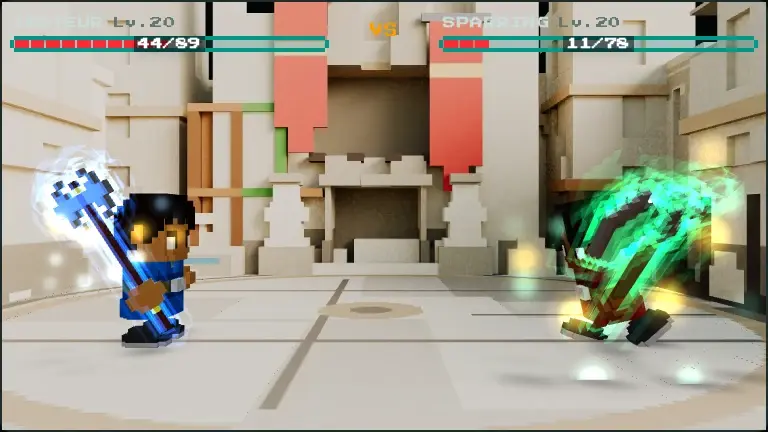
The castle, from level 10
The rule is deliberately simple. Up to level 9, all your fights take place in the clearing, as before. From level 10 onward, each fight is played in one of the two arenas, drawn at random.
That threshold isn't arbitrary. The first levels go by fast, and that is when you learn to read a fight: who strikes, who dodges, what a skill triggers. Changing the scenery at that point would add noise without bringing anything. Past level 10, you know how to read a fight, and seeing a new arena show up becomes a small reward in itself.
The castle replaces nothing: the clearing stays in the rotation, with each setting hosting roughly one fight in two.
Why the draw is locked in
An invisible but important detail: a fight keeps its arena forever.
The arena isn't drawn when you watch the replay, it is derived from the fight's own identifier. Three concrete consequences:
- You reopen an old fight in your log: it is the same scenery as the first time.
- You share a fight's link: your opponent sees exactly the same scene as you.
- Your brute passes level 10: your old fights stay in the clearing, they aren't rewritten after the fact.
That is the philosophy of the combat engine, which replays recorded turns rather than rolling the dice again: what you saw once must stay true.
What it took on the technical side
Adding a setting isn't just loading a second model.
The clearing is an open scene: the game adds a sky, distance fog that fades out the horizon, and a vast grass plane that extends the ground beyond the model. Without them, the forest would float in the void.
The castle courtyard is a closed scene: its walls block the horizon. The sky and the grass plane are invisible there, and the fog actually did harm, washing out the stone in the background as if it were hundreds of meters away. Each arena now describes its own surroundings, and the castle simply has none.
The lighting, for its part, is baked into a texture rather than computed live, just like the clearing. That is what gives soft shadows on the stone without costing a single calculation during the fight, on mobile and desktop alike.
One last detail: the game only downloads the arena of the current fight. Each setting weighs several megabytes, and loading both every time would have slowed everyone down for nothing.
What's next
Two arenas is a start. The ideas on the table:
- More settings, unlocked higher up, so leveling keeps changing the landscape.
- Context-based arenas rather than random ones: a prestige setting for fights at the top of the ladder, for example.
- Life in the scenery: subtle animated details that don't steal the spotlight from the fight.
In the meantime, if your brute is past level 10, your next fight has a one-in-two chance of taking place within the castle walls. You can also watch one right now, or read how the weapon trail has been reworked since.
Go take a look.